

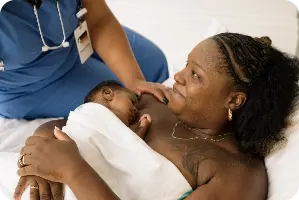
Your Birth Story Matters.
Every Story Shapes Better Care.
Black Mamas in Cincinnati: We Want to Hear From You
Mama Certified was created by Black mamas through Queens Village, in partnership with local hospitals, to give you clear information about pregnancy and birth. Because Black mamas too often face unfair treatment and worse health outcomes, your voice is one of the most powerful tools we have to make care better.
The Birthing Experience Study is how we gather that feedback. If you recently gave birth at a Cincinnati-area hospital, tell us what your care was like. What felt right? What didn’t? What could be better? Your answers go back to hospitals through the Queens Village Hospital Advisory Boards (QVHABs), where Black mamas and hospital leaders meet to turn real experiences into real change.
Together, we’re building a region where every Black mama feels safe, informed, respected, and empowered throughout pregnancy, birth, and postpartum care.
Who Can Share Their Story?
The survey takes about 15 to 20 minutes, and your answers are confidential.
You can take the survey if you:
- Identify as Black or African American
Are 18 or older
- Gave birth at a participating Cincinnati hospital between November 2025 and now
As a thank-you for your time, every mama who completes the survey receives a $50 gift card.
Ready to Share Your Story?
Your answers are confidential.
What Black Mamas and Providers Said: Phase II Birthing Experience Report
Black mamas asked for transparency and accountability in their care. Mama Certified listened. In Ohio, Black mamas are more likely to die from pregnancy-related causes, and 88% of deaths during and after pregnancy are preventable. That’s why your voice matters.
The Birthing Experience Study, led by Dr. Dorian Odems, heard from 251 Black mamas through the survey, and 17 mamas and 15 doctors, nurses, and midwives through in-depth interviews. More than 3 out of 4 mamas said their care was good or excellent, but nearly 1 in 4 (23%) rated their care fair or poor. Getting support and quick help when they needed it scored lowest of all areas, and not every mama felt heard or included in decisions.
Together, mamas and providers named three things that need to change. Here's what that means for Black mamas:
Structural Change
Systems and policies that shape how care is delivered need to be redesigned with Black mamas in mind.
- Every mama deserves fair care, no matter her race or background. Hospital policies should work the same for every mama.
- Mamas deserve to be heard when something goes wrong. Their concerns should lead to real action, and staff should be held accountable for harmful or unfair care.
- Mamas deserve to see themselves in their care team. Mamas asked hospitals to hire more Black doctors, nurses, and staff.
- Every mama deserves the same quality care every time, with hospital leaders responsible for making sure it’s fair.
- New: Mamas deserve a care team they know. Mamas asked to see the same doctor or team through pregnancy and birth, so trust can grow.
Provider Training
Care teams should be trained to listen, earn mamas’ trust, and treat every mama with respect.
- Mamas deserve respect from everyone who cares for them. Mamas asked for anti-racism, bias, and de-escalation training for all providers.
- Mamas deserve clear answers. Care teams should explain options, risks, benefits, and pain relief choices before mama decides.
- Mamas deserve care teams that learn from their stories and use that feedback to improve.
- New: Mamas deserve to be believed. When a mama says she’s in pain, her care team should listen, check on her often, and act fast if her pain medicine isn’t working.
Patient Power
Black mamas deserve a real voice in decisions about their care, before, during, and after birth.
- It’s mama’s choice. Mamas have the right to ask for more time or say no to an intervention, including induction or a C-section.
- Mamas can bring their people. Doulas and birth companions are an important part of the care team and should be welcomed.
- Mamas’ concerns matter. Their symptoms, pain, and feedback should be taken seriously, without fear of being brushed off.
- New: Mamas know their rights. Mamas can say no to residents (doctors in training) in the room, refuse an intervention, or ask for more pain medicine.
- New: Mamas deserve real breastfeeding support before, during, and after birth, so they feel confident feeding their babies, not just help with the first latch
This report is more than numbers. It’s a roadmap, shaped by mamas’ stories.
Past Reports Archive:
2025 Birthing Experience Report (Phase I).
The first round of the study heard from more than 240 Black mamas and 10 hospital-based providers. Their stories set the starting point for this work and named the three changes that guide it today.